

BJJ Belting System
Brazilian Jiu Jitsu (BJJ) is widely known as one of the most effective martial arts in the world. It’s a discipline that emphasizes leverage, strategy, and technical knowledge over sheer strength, making it a martial art where smaller practitioners can successfully defend against larger opponents. Beyond the techniques and philosophy, one of the most recognized features of BJJ is its belt ranking system.
The BJJ belt order represents a practitioner’s journey through the art — from complete beginner to seasoned Professor. Each belt has its own meaning, skill requirements, and time frame - earning one is often the result of years of dedication. Unlike some martial arts where belts can be earned relatively quickly, BJJ belts are notoriously hard-earned, with the black belt often taking a decade or more of consistent training.
In this detailed guide, we’ll cover everything you need to know about BJJ belt ranks:
o - The standard belt order for kids and adults.
o - What each belt represents in terms of skill and mindset.
o - The time-frames and requirements for promotion.
o - Differences in ranking systems across federations like IBJJF and JJGF.
o - What happens after black belt, including coral and red belts.
o - The role of stripes and degrees in tracking progress.
By the end, you’ll have a complete understanding of the Brazilian Jiu Jitsu belt order and what each rank means in the journey.
🔹 The Belting Systems in Brazilian Jiu Jitsu
In Brazilian Jiu Jitsu, belts are awarded based on technical growth, rolling performance, consistency, teamwork, mindset, competition performance, and responsibility on the mat - not simply on attendance. Unlike some martial arts with frequent promotions, BJJ requires years of practice and consistency at each rank. There are two main systems; the Adult system and the Kid's system for practitioners under the age of 16.
🔹 Adult Brazilian Jiu Jitsu Belting System
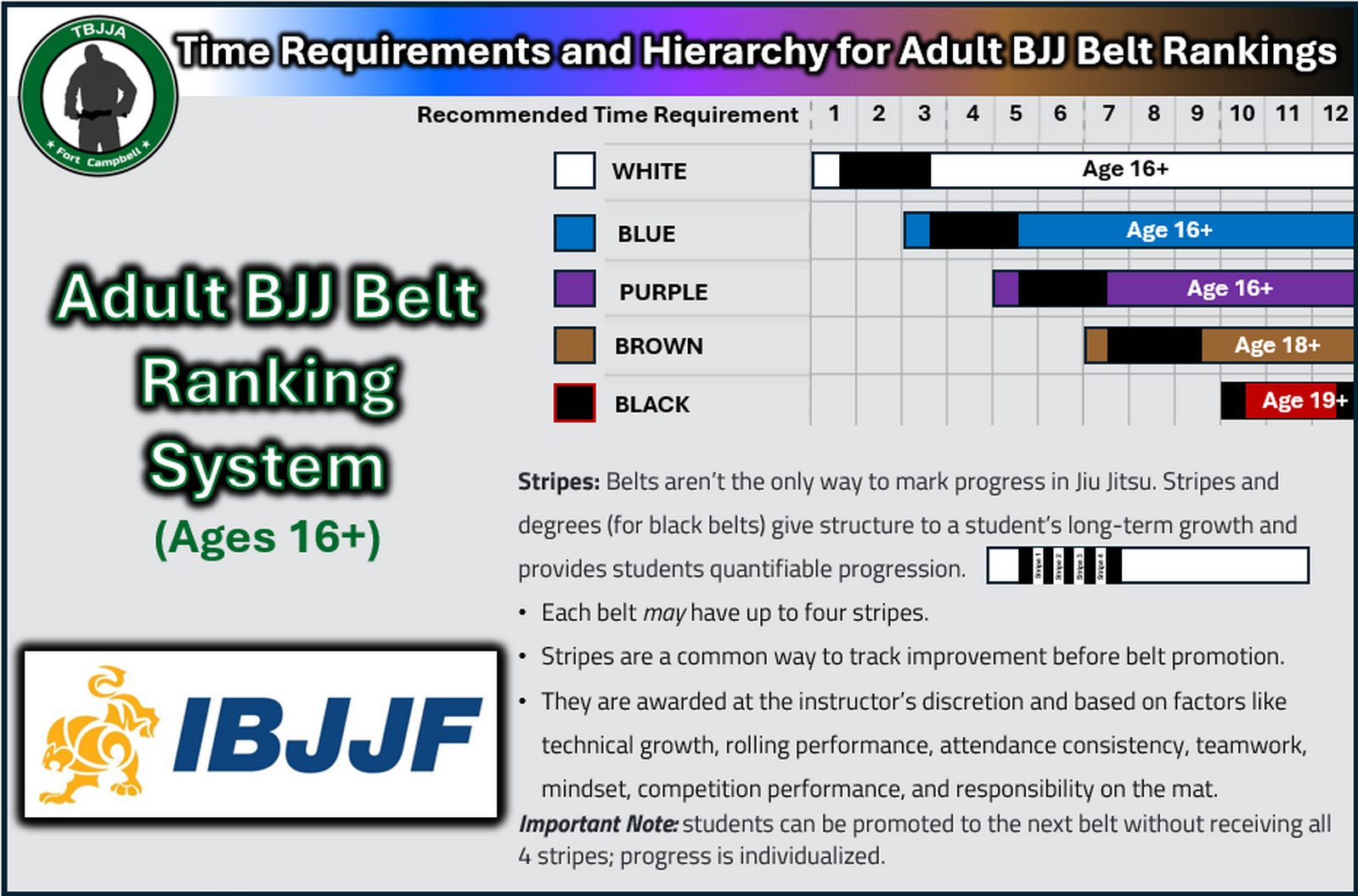

Meaning: A symbol of starting fresh, with no knowledge. It’s the foundation where students learn survival skills, defensive posture, mat etiquette, and the rules of rolling.
Focus Areas:
o - Basic Guard concepts
o - Basic BJJ movements (Shrimping, Break Falls, Framing, etc...)
o - Managing distance
o - Introductions to Take Downs
o - Introductions to Submission holds
o - Escapes from common disadvantageous positions
o - General BJJ Mat etiquette, hygiene, clothing choices, etc...
Time-frame at this belt level: 1-2 years on average
Mindset: Learn, absorb, and survive. White belts are encouraged to focus on the fundamentals (statistically common BJJ positions/moves). Many Professors say that the White belt is the HARDEST belt to earn in BJJ, as it requires a brand new BJJ athlete's initial commitment to sign up and just start.

Meaning: Mastery of basic techniques and the first major BJJ milestone. Many practitioners quit before reaching this belt, making earning this belt a highly significant milestone.
Focus Areas:
o - Becoming comfortable in multiple positions (e.g. identifying potential threats, predicting off balances, understanding Frames, etc...)
o - Submissions with setups and counters to submission attempts
o - Understanding transitions between positions
o - Beginning to develop a personal game (guard passing, guard retention, sweeps)
Time-frame at this belt level: 2-3 years on average (IBJJF requires 2 years before purple belt promotion)
Mindset: Experimentation. The blue belt stage is about exploring styles and figuring out what works best for the individual, based on their individual athleticism, grappling background, body type, age, etc... This cannot be effectively done until the athlete becomes comfortable with failing while in new positions or while attempting new skills. Your ego is not your amigo at this stage of your development.

Meaning: Considered the “Engineer’s Belt.” Purple belts are seen as advanced BJJ practitioners capable of teaching lower ranks while they further develop their own personal game
Focus Areas:
o - Sharpening technical precision
o - Attacking combinations and chaining submissions and sweep attempts
o - Developing strong defenses as well as offense attacks from multiple positions
o - Further development of an effective individual BJJ game, based on the individual's athleticism, body type, age, etc..
o - Identify weak areas of their game and make concerted efforts to strengthen those areas
o - Assist lower belts with fundamental skills and movements
Time-frame at this belt level: 2-3 years, though often longer (IBJJF requires at least 1.5 years at purple).
Mindset: Mastery of BJJ fundamentals while building a strategic and creative individual game. Chaining attacks through planned positional progression strategies. Additionally, Purple belts usually are looked up to by most lower belts as to what 'right looks like,' so they should start experimenting with leadership and assistant instructor roles under the watchful eye of a more experienced instructor.

Meaning: A transitional belt before black. Brown belts are expected to be technical, polished, and capable of dominating rolls.
Focus Areas:
o - Refinement of techniques to high efficiency
o - Comfortable in any defensive or offensive position - has answers and counters for most situations
o - Increasing efficacy from all positions
o - Fixing weaknesses and solidifying strengths
o - Leadership on the mats - setting a good example and often helping coach lower belts or running their own classes
Time-frame at this belt level: 2-3 years, though often longer (IBJJF requires at least 1 year at Brown)
Mindset: Focused on small details, increasing precision and efficacy, and leadership within the gym culture.

Meaning: Black belt is NOT the end of progression; it is the beginning of a whole new evolution of BJJ skill sets - mostly revolving around instruction and further development of overall BJJ knowledge. Black belts are extremely technical, polished, and capable of dominating rolls when/if they so choose. #ForeverWhiteBeltMentality
Focus Areas:
o - A deep understanding of the fundamentals — and the ability to apply them with precision, efficiency, and timing
o - All movements have a specific purpose
o - Wasting as little energy as possible - efficiency > all at this stage of development
o - Understands (and can explain) when to act — and more importantly, when not to
o - Continues to learn and develop their own game
Time-frame at this belt level: Life! There are up to 6 degrees a Practicioner can earn on their Black belt, and there ARE belts beyond Black belt (Coral and Red Belts at the highest levels); however, they are only held by a handful of founding members of the BJJ art.
Mindset: Focused on small details, increasing precision and efficacy, instruction proficiency, and leadership within the gym culture.
🔹 Kid's Brazilian Jiu Jitsu Belting System
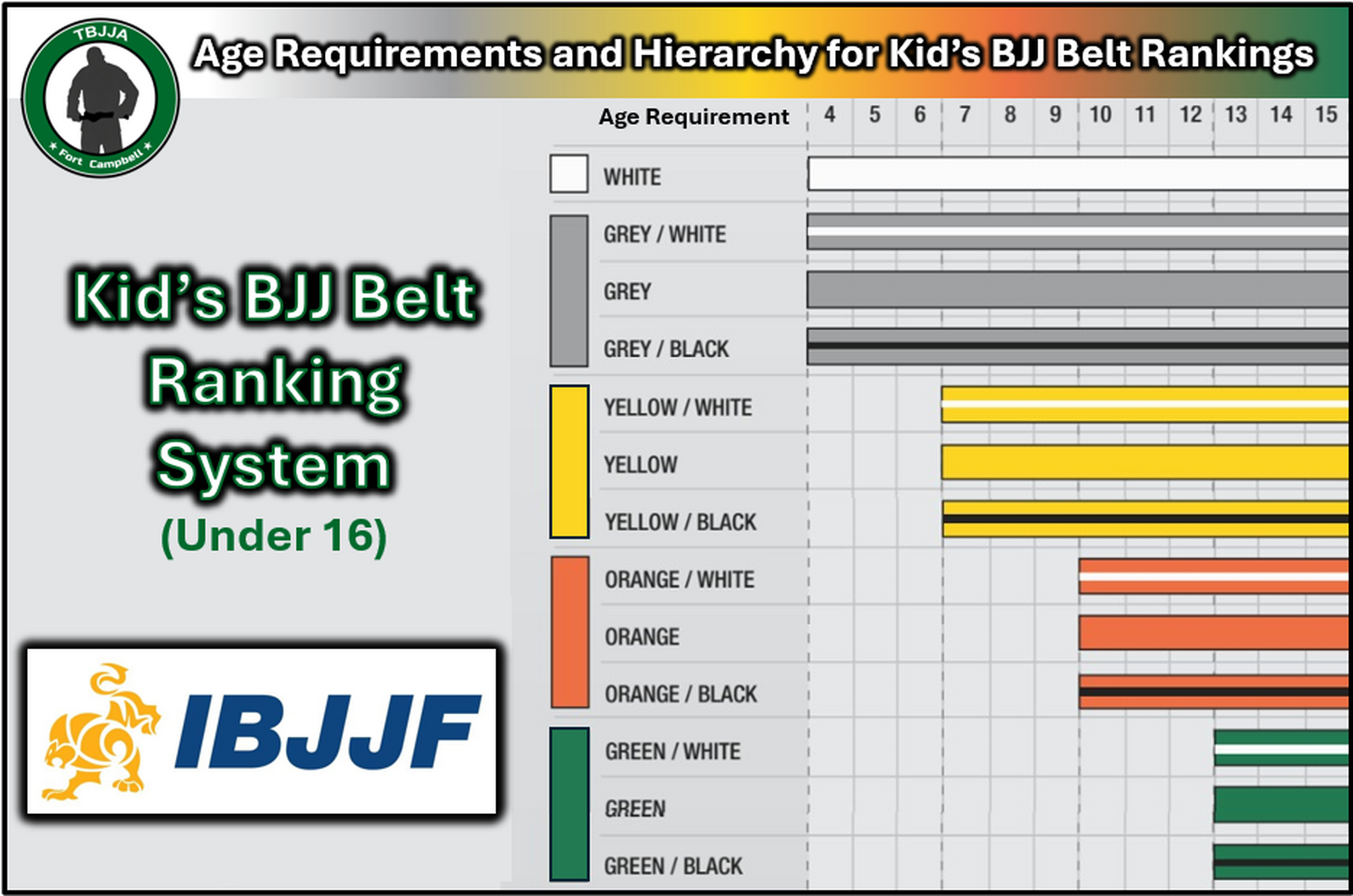
BJJ belt rankings for kids are designed to encourage growth, motivation, and focus at every stage with a higher periodicity than the adult system. Instead of the adult five-belt path, children progress through a series of belts (13 total) that reward consistent effort and technical improvement.
Each belt comes in three versions: white-striped, solid, and black-striped. Between each belt, kids may earn up to four stripes, typically based on attendance, effort, attitude, and progress.
Promotions aren’t just about performance or attendance; they also recognize attitude, discipline, and consistency. TBJJA Fort Campbell use a stripe system to help keep students engaged between belt promotions.
Children progress through these belts in order, regardless of their starting age. The IBJJF system allows students ages 4 to 15 to follow this path at their own pace.
What happens when my child turns 16?
At age 16, students are required to transition into the adult belt system. According to IBJJF rules, this applies based on birth year, even if the athlete hasn’t reached their birthday yet.
Any student who holds a colored kids belt—Gray, Yellow, Orange, or Green—must be promoted to Blue Belt at this point.
Students who are still White Belts at 16 remain White Belts under the adult system until eligible for promotion.
Promotions beyond Blue Belt (e.g., to Purple) are only permitted after meeting strict time and age requirements established by the IBJJF.